Adventures. That’s what my friend Joanne and I called our treks to out-of-the-way places for lunch, sight-seeing or shopping. Sometimes we were gone most of the day. That stopped when I realized I couldn’t leave my husband on his own for so long. So one day Jo and I decided we’d walk right around the corner to Lefty’s for lunch.
“Peter, come with us,” Joanne said.
“No, no, I’m good,” he said. I knew he really didn’t want to listen to us chatter the way we do.
The restaurant is quite small, so we went early to beat the lunch crowd. Our mouths were going faster than the traffic outside when I, facing the street, saw Peter walk past.
“Wonder where he’s going?” I said. I wasn’t worried because he often walks to the grocery a block further. We took our time over lunch. When we got up to leave, I glanced at a table a few feet away, and there sat my husband, his back to us, with a beer in front of him.
Neither Joanne nor I saw him come in. We sidled over to his table and I slid into the chair beside him. “Can I take your order, Sir?” I asked.
He was startled. “I’ve already eaten,” he said, straight-faced. Joanne started laughing.
“I saw you walk past an hour ago.”
“I came back…!”
“Didn’t you see us?” I asked.
“No, didn’t you see me?”
“No, but you must have looked right at us when you came in…”
“I didn’t see you.”
That shouldn’t have surprised me. It isn’t unusual for my husband to come into the room and not see me sitting on the sofa. I wasn’t surprised that we hadn’t seen him since we were at a right angle to his table and his back was to us.

Artist Rebecca Murtagh’s, Post-it notes installation, Hamilton College, Clinton, NY
A few weeks later, our friends Jerry and Shelia were here. We were going to Lefty’s for dinner, and I told them about Peter not seeing Joanne and me there one lunchtime. They laughed, as did Peter, though I was sure he didn’t remember the day. I stage-whispered to Jerry, “Good stuff for my blog.” He nodded. I should have made a note.
We went around the corner, and while we waited for our food we amused ourselves trying to identify the photos of famous lefties beside our table. We knew da Vinci and Rembrandt, Einstein and Edison, but were stymied by a man I thought was Woodrow Wilson (Henry Ford), and a woman who, we found out, was Helen Keller. Peter joked he’d never met any of them.
As we carried on like the old friends we are, I suddenly thought, this is good stuff, too, but the idea I’d had a few hours earlier hadn’t stuck. I asked Jerry if he remembered my idea.
“Unh uh…oh, Lefty’s!” he blurted.
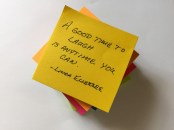
Shelia hooted. “You two can’t remember the story and we’re in the restaurant where it happened!” She looked at my husband and laughed. “Pete, who has memory problems now, hm?”
Shared laughs are the best.

 Art Fry, co-creator of Post-It® notes, started using the “light tack” notes — 3M’s “solution without a problem” — to mark his hymnal at choir practice. Art’s bright idea is one I use to help Peter, and should use to help myself!
Header photo: Rainbow of Post-It notes.
2016 National Society of Newspaper Columnists’ contest finalist. 


 Dementia isn't funny.