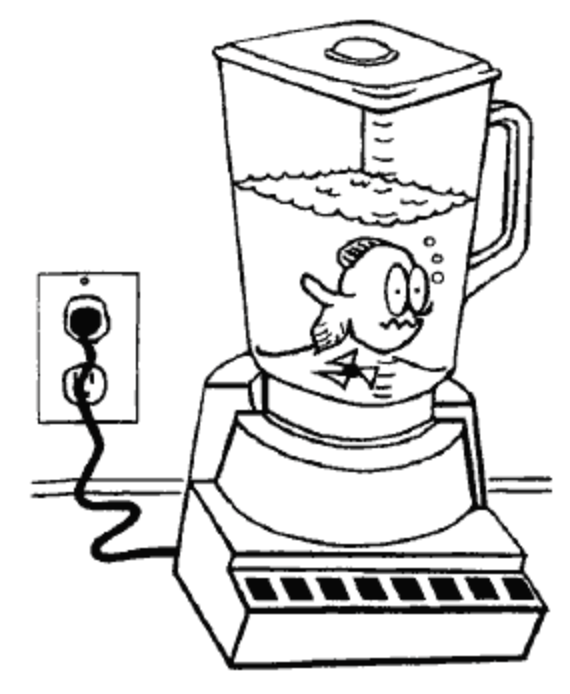
Attention span of a goldfish.

Screen Shot 2015-08-19 at 3.16.32 PM

Ten symptoms of caregiver stress were listed in an Alzheimer’s Association newsletter with this caveat: Alzheimer’s caregivers frequently experience high levels of stress. It can be overwhelming to take care of a loved one with Alzheimer’s or other dementia, but too much stress can be harmful to both of you.

 No kidding!

Screen Shot 2015-08-19 at 3.14.18 PM

In any given day I deal with several of these, and I’m sure other caregivers do the same:

  1. Denial – Early on, I was convinced that if I kept trying to force Peter to remember things, to eat right, to get out more he’d at least maintain his status quo.
  2. Anger – Screams, like geysers ready to erupt, lurk just below the surface of my “looking for laughs” demeanor. 
  3. Social withdrawal – Sometimes it takes too much effort do anything at all, much less be sociable.
  4. Anxiety – I’ve finally done what I should have done sooner: hired more help for Peter and for me. What a difference to have the house cleaned and tidied by a young lady who is energy personified, the garden maintained by a woman who knows first-hand what it’s like to be a caregiver, niggling tasks done by a handyman friend.
  5. Depression – Big mistake to think that I didn’t need anti-depressants. Hindsight and a meltdown proved me wrong.
  6. Exhaustion – I used to keep my house to a certain standard, not the same white-glove-test standard my mother used, but I kept the dust bunnies at bay, food in the fridge, cookie tin filled, laundry done. When I realized it had been weeks since I’d cleaned the bathroom or changed our sheets, I knew I needed more help. (see #4)
  7. Sleeplessness – Guilt wakes me in the wee hours, especially when I’ve crabbed at him for things he can’t help. Peter’s attention span is worse than a goldfish’s and he’ll ask the silliest things over and over. Within a few seconds he forgets I yelled and when I apologize he doesn’t know why.
  8. Irritability – No one has ever called me patient. Lately Peter has started reorganizing the pantry every few days, lining up jars and moving boxes so I can’t find anything. Most wives would be thrilled if their husbands undertook that task, but I’m an angry bumble bee.
  9. Lack of concentration  – I used to be so organized, so tidy, but no more. My personal spaces are in the same sorry state as my mind.
  10. Health problems – Many times I wonder if his dementia has rubbed off on me. Am I losing control too? Is it stress, or am I destined to be a statistic as well?
    I talked to my doctor. He did the basic tests and I passed. “Stress,” he said, “it’s stress. You’re doing fine, but take time for yourself, do what you can to alleviate stress.”

My mother always said, no matter how bad things may seem, there’s always someone who is worse off than you. I’m glad I’m not a goldfish.
 

Screen Shot 2015-08-19 at 3.24.59 PM

2016 National Society of Newspaper Columnists’ contest finalist. 

 

Have I done him wrong?

This sentence from an Alzheimer’s Association website article jumped right off the screen at me:

Most people living with Alzheimer’s Disease are not aware of their diagnosis.

What?

“Despite…the benefits of clear and accurate disclosure,” the article continued, “[only about 45 percent] of seniors diagnosed with Alzheimer’s…[have been] told the diagnosis by their health care provider.” And their caregivers don’t know either. On the other hand, more than 90 percent…of cancer and cardiovascular patients do know their diagnoses.

Whoa-a!

There is still only one way to diagnose Alzheimer’s definitively and that’s through brain autopsy. If the person exhibited Alzheimer-like symptoms while alive and the brain tissue contains the microscopic physical abnormalities typical of the disease, a definitive diagnoses can be made.

Physicians can correctly diagnose Alzheimer’s disease about 90 percent of the time while the patient is alive, based on mental and behavioral symptoms, physical examinations, neuropsychological tests, and lab tests.

But there’s still no cure.

Screen shot 2015-05-18 at 8.25.49 AM

Every 67 seconds, someone in the US develops Alzheimer’s.

Peter’s neurologist diagnosed his dementia about seven years ago. She didn’t use the “A” word, rather she said simply, “Dementia.” I breathed a sigh of relief, and when we got into the car to come home, I started crying. Peter wondered why.

“Because you don’t have Alzheimer’s,” I said, “it’s ‘only’ dementia.”

“Is that good?” he asked.

“Well, no, but it’s better than Alzheimer’s,” I said.

Screen shot 2015-05-18 at 8.25.38 AM

By 2050, there could be as many as 16 million people with Alzheimer’s.

He asked no further questions then or since. Every now and then he’ll say his memory is getting worse, so I remind him it won’t get better. I’ve never used the dreaded “A” word, but I wonder if I should? Deep down, does he know?

Have I done my husband a disservice by not laying it out? Should I attempt to do it now? If he already knows or suspects, he would never say anything. That’s not his style. He’s always played things close to his chest.

Screen shot 2015-05-18 at 8.25.28 AM

More than 5 million Americans have Alzheimer’s.

Experts advise telling patients and families because
of the need to:

  • Plan for the future
  • Take care of financial and legal matters
  • Address potential safety issues
  • Learn about possible future living arrangements
  • Develop support networks

Been there, done all that, without having The Conversation. Have I done him wrong, to paraphrase a line from an old Mae West movie? I don’t know.

Screen shot 2015-05-20 at 5.30.52 PM

I really had to look hard for something to fulfill my laugh-a-day pledge. This one works for me. Hope it does for you.

The doctor says to his patient, “I have good news and bad news.”
‘Tell me the bad news first, Doc.” 
“You have Alzheimer’s disease.”
“Oh no! What’s the good news?”
“You can go home and forget about it.”


Graphics Alzheimer’s Organization©

2016 National Society of Newspaper Columnists’ contest finalist. 

Which end up?

Former NBC “Today” anchor Katie Couric had a colonoscopy on live t.v. fifteen years ago, remember? Surely I could write about the subject, if delicately put.

It was my husband’s turn a few weeks ago, not on t.v. of course, though a situation comedy came to mind — Jackie Gleason’s, perhaps.

“Why do I have to have one?” Peter demanded as I handed him four little pills to start the cleansing process.

“Because you had polyps five years ago,” I said.

“Does everyone have colonoscopies?”

“They save lives,” I preached, “and they’re recommended for everyone 0ver fifty.”

He grumbled.

No one likes to prep for a colonoscopy, but a patient with dementia is “lucky.” He won’t remember from one minute to the next why he has to drink quarts of gritty stuff dissolved in an electrolyte-filled sports drink, why he can’t eat for twenty-four hours, nor why he shouldn’t take the dog for a long walk lest he get caught short!

Peter is not a morning person so his early appointment wasn’t to his liking either. We waited just minutes before the nurse called him. “I’ll come too,” I said.

“No, I’ll get you when he’s ready.”

I knew she’d be back quickly. “Mrs. Clarke, come with me, please.” She chuckled as we walked. “When I asked Mr. Clarke why he was here, he didn’t know.”

“He can’t remember,” I said.

“He thought endoscopy?”

I laughed. “Um, no, wrong end. Colonoscopy.”

After she’d taken his BP, asked more questions (which I answered), and started an IV, she left so he could undress and put on a hospital gown. He didn’t understand why he had to take all his clothes off — he’d keep his knickers on, he said. “Nope, those too,” I insisted, as I tied him into a gown obviously designed for someone three times larger than my skinny husband.

Soon, our jolly, effervescent gastroenterologist popped in, offered a few reassuring words, and away they went.

Peter was back within thirty minutes, accompanied by a giggling nurse and chortling anesthesiologist. “Your husband is a riot,” he said. “When Dr. R finished, I asked Peter to open his eyes, but he opened his mouth like he was at the dentist!” Yup, he still had the wrong end!

The doctor came in to deliver good news and bad. “You had four tiny polyps,” he explained, “and they looked ‘fine,’ but we will send them off for biopsy.” Peter’s blank look told me he didn’t understand a word. “But the good news is, it takes about seven years for any new polyps to become cancerous, if they’re going to, so no further colonoscopies will be required.  In other words, age will probably claim him before an attacking polyp. “Sounds terrible, that option,” the doctor whispered to me.

I shook my head. “He’d rather that than another prep.” Peter waggled his eyebrows in agreement.

The doctor showed off the “beautiful pictures” of Peter’s colon as if they were photos of his grandchildren. I raised my left eyebrow to say that only a gastroenterologist would think they were pretty! That prompted him to trot out a joke from his vast repertoire, this one about Yankees. I reminded him, a Southern gentleman, that I’m a Yankee.

He was undeterred. “Yankees are like hemorrhoids. When they come south, they’re a pain in the ass, and the pain doesn’t go away until they head back up north.”

2016 National Society of Newspaper Columnists’ contest finalist. 

 

Magic pills? Wonder drugs? Snake oil?

She’s his advocate, his ears, his caregiver. She’s an attractive blonde, late forties perhaps, who takes care of her father in a new tv commercial. They look alike and maybe they’re really related. Perhaps it isn’t a made-for-tv reenactment.

The spot promotes Namenda (memantine hydrochloride) XR, a medication long prescribed for people with moderate to severe Alzheimer’s. The new extended release (XR) version, with seven additional milligrams of the active ingredients, offers once-a-day convenience. Used in combination with another commonly prescribed drug, Aricept (acetylcholinesterase inhibitor, AChEl), the two may keep symptoms from worsening, at least for a while.

This is one of those commercials that urges you to ask your doctor about this drug for your loved one. An announcer gives the laundry list of side effects: nausea, Screen shot 2015-01-31 at 5.05.22 PM_2vomiting, diarrhea, constipation, loss of appetite, dizziness, tiredness, weight loss, swelling in hands or feet, fast heart rate, easy bruising or bleeding, unusual weakness, joint pain, anxiety, aggression, skin rash, redness or swelling around eyes, or urinating more than usual. Makes you wonder why you’d want something that might add to your loved one’s misery. Frankly, I think all those “ask your doctor” commercials should be banned, but that’s a post for another day.

Peter has taken both drugs for more than five years with no side effects. His neurologist asked recently if I thought the meds were helping. “How would I know?” I said. She shrugged.

The commercial oozes warm fuzzies. We see the concerned, loving daughter, her young children, and her sweet-faced father who is included in their activities, but who seems vacant, absent. “All my life he’s taken care of me,” she tells us, adding that it’s her turn to take care of him.

All well and good, and we love her for her dedication. But, jeez, am I alone in wondering why we never see the caregiver’s frustration? Neither medication is a cure. The best science can do is slow the disease for a while.

And what can science do for caregivers? Is there a magic pill for us?

If a camera were mounted in a corner at our house, it would record smiles, yes, and silly laughter, but it would also record heated talk, lip-biting, teeth-gnashing, hair-pulling, and tears behind slammed doors. The camera would see me trying to read, uninterrupted, for fifteen minutes. It would see someone else cooking, cleaning, making appointments, counting out pills, and making endless cups of tea to sooth upsets, his and mine.

Oh yes, I know there is help for some of those tasks, but I can’t—won’t, not yet—delegate most of them. Our wedding vows weren’t the traditional ones, but I did, “…promise to honor and tenderly care for you…through all the changes of our lives.”

A camera would also see the occasional enveloping hug, and Peter asking, as he always does, “What would you do without me?” At my eyebrow-raised, tilted-head glance, he would change his question to, “I mean, what would I do without you?”

And, as we always do, we’d laugh at his little joke. Truth is, I often don’t know what to do without him.Screen shot 2014-09-13 at 11.08.38 AM

Header photo: Peter and I at river’s edge, 2014.

2016 National Society of Newspaper Columnists’ contest finalist. 

Memory loss associated with Alzheimer’s reversed for first time

I found this  post on Mark Wheeler’s “Seven Spheres” blog. I’m forever reading about all the facets of this huge umbrella under which we live — dementia. I grasp at any straw. The fact is that Peter is nearly 77, set as solidly in his ways as if he were cast in cement, and stubborn to boot. I’d love to try the methods described in this article, but I don’t think he’d go along with it, nor would I have the strength or patience to keep prodding. But by reblogging Wheeler’s post here, I hope at least some of my caregiving followers can glean help from his words and the research behind them.

Alzheimer’s: the elephant in the room.

In 1906, Dr. Alois Alzheimer identified the disease that came to bear his name. In 1979, Alzheimer’s Disease (AD) caused 875 deaths in this country. That was the first year AD was identified as a separate cause of death. By 1993, more than 18 thousand people in the U.S. died from AD.

• Approximately 5.3 million Americans currently live with AD.
• Some 200 thousand of that number have early-onset AD — people in their forties and fifties.
• Every sixty-eight seconds another American is diagnosed.
• AD has been listed as the sixth leading cause of death after heart disease, cancer, chronic lower respiratory disease, and accidents. However, in March, 2014, the American Academy of Neurology reported AD is now the third leading cause of death.

Warning signs of AD:
• Profound memory loss
• Inappropriate behavior or behavior swings
• Apparent confusion and agitation
• Difficulty with spoken or written language
• Difficulty with routine tasks, such as bills
• Problems with vision and understanding spatial relationships
• Signs of impaired judgment and reasoning

Screen shot 2014-09-03 at 12.04.53 PM

Whenever I walk into a room, everyone ignores me. (Coldell cartoon)


Dementia is a symptom.  AD is one cause of the symptom. Dementia is considered the general term for decline in mental ability severe enough to interfere with daily life, memory loss for example. Experts agree that AD is the most common and accounts for as many as 70 to 80 percent of all cases.

Among dementia’s many other causes are Lewy Body disease, Parkinson’s disease, Vascular or multi-infarct dementia, fronto-temporal, and thyroid disease. Most are not reversible, rather they are degenerative diseases of the brain that get worse over time.

Too often, a doctor will tell the patient that he or she has “a little dementia” or in my husband’s case, “mild dementia.” Patient and family leave the office feeling relieved that it’s only dementia and not Alzheimer’s. I know I did. When we got into the car to come home I started bawling. Peter wondered what was wrong with me. I almost never cry.

“I thought she was going to say you have Alzheimer’s,” I told him.

“You mean I don’t?”

“No! It’s just dementia.” We even went to our favorite place for coffee and pastries to celebrate.

“Dementia” isn’t funny, but laughter in large doses does help. I can no longer ignore the elephant.

Screen shot 2014-08-12 at 8.55.42 AM

Sipress cartoon.

 [Facts and figures taken from on-line sources which show varying, but similar, statistics.]

Header photo: Rain on my sunroof.

2016 National Society of Newspaper Columnists’ contest finalist. 

‘The road to senility is paved with plaques.’

My grandmother was widowed at fifty-eight. She learned to drive — proudly, badly — when she was sixty. Grandma tended a vegetable garden, fretted over her roses, played bridge with friends, and watched “As the world turns” religiously. She managed well enough on her own for fifteen years or so with help from my dad and his sister.

Then grandma began to talk endlessly about “lime lighters.” No one knew what she  meant. She’d always been a little bit ditzy, but by the time she reached her eighties, she didn’t know any of the family, she tried several times to grind up her sneakers in the garbage disposal, and, obviously, she could no longer live on her own, much less drive the car she was so proud of. Dad sneaked her car away in the night, parked his own car in her garage, and told her he’d bought her a new one.

She never questioned him, nor asked for the keys.

The doctor said she was senile.

Grandma was in a nursing home when she died of “old age” according to her obituary. She was ninety-eight.


Screen shot 2014-08-23 at 6.38.15 PM


For days, weeks, I’ve been searching for simple definitions of senility, dementia, and the way Alzheimer’s Disease fits into the puzzle. Medical experts don’t even agree necessarily.

When I found the quote below on “Yahoo! answers” it was exactly what I’d been looking for: simple, easy-to-understand, and written by someone with professional and personal experience. His answer:

Senility is an old-fashionied word for dementia. Dementia is progressive loss of cognition or mental faculties due to damage of brain tissue, and is often associated with aging. Not everyone who has dementia is elderly, and some elderly people have memory  loss that does not meet the full criteria for true dementia. My [the writer’s] mother had dementia, [and] it got to where she didn’t even know who my father was. She used to be a nurse, [and] when she was taken to the nursing home she thought she was working there.

Photo on 2014-05-10 at 13.54_2

Me hiding behind beautiful bouquet the florist delivered.


Header photo: “Knock Out” rose flourishes in our garden.

2016 National Society of Newspaper Columnists’ contest finalist. 

High fives and woohoos!

Two days ago Peter had a three-month follow-up with the neurologist. This was an extra one fitted in to satisfy questions from our long term care insurance. They would not be satisfied with the reams of paper and hundreds of answers I’d provided.

After the usual weight, blood pressure, medications’ check and general chit chat, the doctor told Peter the real reason we were there. “I need to ask you a lot of silly questions,” she said apologetically, “things your insurance wants to know.”

He nodded as if he understood, and maybe he did.  We’d been through this so many times already.

“OK, here we go,” she said.  “Can you tell me what year this is?”

“I know it’s two-thousand something…two-thousand fourteen?” He looked like a little kid, worried lest he give the wrong answer.

“Yes!” she said. I smiled

“OK, what  month?”

He hesitated. “August, maybe?”

“Yes!” The doctor and I raised our eyebrows.

“What season?”

“Summer?” He was gaining momentum, though he punctuated each answer with a question mark.

“You’re doing well.  Now, what day of the week?”

“It’s not Thursday, I know that.  Monday?”

We cheered.

Then she told him she would name three things for him to remember. “I’m not going to give you the ones I always use,” she said, “because that’s too easy for you.” Not really true any longer because he hadn’t been able to repeat her “firetruck, airplane, house” in several years.  “This time I want you to remember, ‘car, banana, backpack.’ OK?”

He nodded and repeated the words to himself.

She continued questioning: what state, what county, what floor of the building? She held up a pen, a note pad, her glasses, a tuning fork.  He stumbled only on tuning fork and county.  He knew what a tuning fork was for, but couldn’t say the name. Close enough. And I don’t think he’s ever known the name of our county.

“Now…can you tell me the three words?”

He concentrated, but shook his head no.

Then she asked him to count backwards from one hundred by sevens.  Usually he can do this faster than I could with a calculator, but he was hestitant. “Start over,” she suggested.  His second try he kept going until she said he gone far enough. He’d aced that test…again.

Next, the date.

He answered quickly. “Eighteenth!”

I woohooed and the doctor clapped her hands. “You’ve done very well,” she said, “I’m very impressed!” He was so pleased with himself he was actually blushing.

“But it’s not the eighteenth…is it?” I said. But, yes, it was — Monday, August 18. Then I remembered I’d told Peter it was the nineteenth on all the forms he’d just filled in. They had a good laugh at my expense.

The doctor totaled up Peter’s score — twenty-five points out of twenty-seven. That was his best score since his baseline exam years ago.

August 18, 2014 was definitely high five day!

Screen shot 2014-08-20 at 4.41.43 PM

Sweet lavendar bake shop web clip

Header photo: Sun flower on a cloudy day, Zion National Park, Utah, 2011.

2016 National Society of Newspaper Columnists’ contest finalist. 


Sticky matter isn’t the stickum on a sticky note.

We elder folk will soon be the largest demographic. So it follows that as our population ages, discussions about dementia and Alzheimer’s will increase too. There have long been a number of tests that can show the progression of dementia in its many forms. And MRIs are used to show  the nefarious beta-amyloid plaques in the brain. I recently read this in an eye-opening report by Loren Grush, Fox News (3/11/14):

For decades, conducting an autopsy was the only way for doctors to determine if an Alzheimer’s patient had an accumulation of [so-called “sticky”] beta-amyloid plaques in the brain – a major hallmark of cognitive decline. But over the past few years, brain imaging using an experimental radioactive dye has helped physicians confirm the presence of these plaques while patients are still alive. Now, a new multi-center study has confirmed that this type of scanning can detect early evidence of Alzheimer’s disease, predicting future impairment among patients with little to no symptoms. The radioactive dye, florbetapir (AMYViD), works like a chemical stain in the brain.  Once injected into the body, florbetapir binds and sticks to the brain’s beta-amyloid plaques, helping to estimate the extent of plaque buildup throughout the brain’s regions. Then, through positron emission tomography (PET) scanning, a radioactive tracer looks for chemicals in the dye and produces an image highlighting the positioning of the plaques in the brain. …

My question is, if I were thirty years younger, or if Peter was, would either of us want to know if we were likely to get Alzheimer’s?  Hm, maybe, but I’d want to know there was a total cure or some preventative care that could really slow the disease. Otherwise, if we were still in our forties, I don’t think either of us would choose to live with the specter of Alzheimer’s hanging over our heads!

Screen shot 2014-07-23 at 8.53.27 AM

Zahn – faadooindia web clip

After all, a little forgetfulness is expected when one reaches a certain age. Sadly, it’s when “a little” forgetfulness turns into “a lot” of forgetfulness that problems arise.

But there’s always time for a laugh.

Header photo: Predictable tiger lilies.

2016 National Society of Newspaper Columnists’ contest finalist. 

Remember to remember.

Way back in 2003 I scheduled Peter for a baseline neurological exam because he’d exhibited a number of angry flare-ups, so very unlike him. During the visit the doctor gave him three things to remember: fire truck, airplane, tree. He remembered all of them, and did well on all elements of the exam which included knowing the day of week, the date, and drawing a clock with a specific time.

A subsequent MRI showed only tiny amounts of the amyloid strands that “clog” thinking. A good sign, the doctor said.

At follow-up eighteen months later, same standard tests, but when the doctor gave him three things to remember — fire truck, airplane and house — he told her she’d changed her list from the year before. She was pleased he remembered and confessed she’d forgotten what words she usually said. He got good marks that day too, though I knew he wasn’t quite as sharp with answers to her questions, plus his usual teasing repartee was missing.

He didn’t say, but he was worried.  So was I.

Every now and then I’d ask him to remember three things I’d list, tell me the day of the week, or draw a clock.  Remembering three things became more and more difficult, he guessed at the day of the week, but he could always draw a clock.

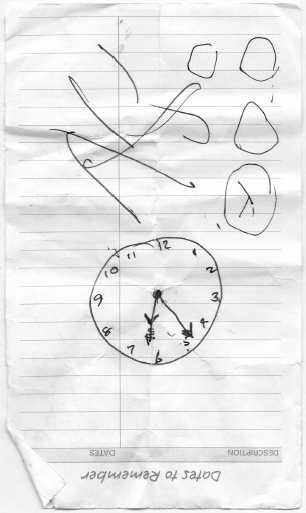
One evening I asked him to draw a clock that showed 6:24.  I tore a page out of my little datebook for him to draw on. “A.M. or P.M.?” he asked.

“A regular old fashioned clock, silly,” I said.

His drawing is below. My scribbles at the top were to show him how a lot of people with dementia draw a clock.  At the bottom is Peter’s clock.  I complimented him on his preciseness, especially the big hand showing twenty-four minutes past the hour. “The little hand isn’t quite right,” I said.  “Close, but no cigar.” Screen shot 2014-08-09 at 12.17.21 PM_2

Nunh unh, no-o,” he said. “When the big hand is coming down, the little hand is moving ’round too. This is right!’

Why did I question an engineer? He was right, of course. The old line, Never ask an engineer the time or he’ll tell you how to build a clock, still applies.

Another year passed and it was apparent Peter wasn’t his old self. Increased memory loss, inability to come up with the words for common items, and confusion about time and place occurred daily. Worse, he was having trouble writing checks to pay bills, and doing routine chores.

Back to the neurologist we went.

She performed those same standard tests. He could no longer remember the three things, nor did he know the day, date, or year. She prescribed commonly used Alzheimer’s drugs: Namenda, to slow dementia’s progression, and Aricept to ease confusion.

Another MRI showed an increase of the “sticky stuff.” Damned plaque! I thought that was only found on teeth.

I scheduled yearly visits.

This past spring the doctor said he was “mid-stage,” though his ability to count backwards rapidly by sevens, another standard test, continues to astonish the doctor and me. I can barely count forward by sevens! But then he is an engineer, numbers and calculations are still easy for him. And he continues to do soduko and crosswords every day, though I’ve noticed a decline in both interest and accuracy.

Though the doctor said “mid stage” I’ve read ahead — he’s exhibiting some “late stage” symptoms. A month ago he couldn’t remember our granddaughter’s name when he saw her picture, he didn’t know what the garbage disposal was for, and simple one-on-one conversations are almost impossible.

Recently, he started working on his 1/78th scale Cutty Sark model ship again — he built the hull and did all the “easy” stuff years ago.  He hadn’t touched it for five years or more. I mentioned this to the doctor because it was encouraging, even though I know there’s no hope for true improvement or cure. She suggested getting him a set of Legos “after he finished the boat.” Peter didn’t react, but I was insulted for him. This isn’t a bathtub toy he’s building after all!

During the visit she asked if he noticed changes in his memory. He said he knew he was “having a hard time,” but he could never forget me. Ah, he can still layer on that olde English charm when he wants to. And the doctor laughed.

Screen shot 2014-08-09 at 12.17.21 PM_3

Laugh anytime.

The next day I happened to come home from a luncheon with my name tag still in place. “Oh, I remember your name,” he said.

“You’d better!” I said.

He pointed to my tag and laughed. I didn’t see that one coming.


Header photo: Rainbow on the eastern shore, Virginia, 2013

2016 National Society of Newspaper Columnists’ contest finalist.