‘The road to senility is paved with plaques.’

My grandmother was widowed at fifty-eight. She learned to drive — proudly, badly — when she was sixty. Grandma tended a vegetable garden, fretted over her roses, played bridge with friends, and watched “As the world turns” religiously. She managed well enough on her own for fifteen years or so with help from my dad and his sister.

Then grandma began to talk endlessly about “lime lighters.” No one knew what she  meant. She’d always been a little bit ditzy, but by the time she reached her eighties, she didn’t know any of the family, she tried several times to grind up her sneakers in the garbage disposal, and, obviously, she could no longer live on her own, much less drive the car she was so proud of. Dad sneaked her car away in the night, parked his own car in her garage, and told her he’d bought her a new one.

She never questioned him, nor asked for the keys.

The doctor said she was senile.

Grandma was in a nursing home when she died of “old age” according to her obituary. She was ninety-eight.


Screen shot 2014-08-23 at 6.38.15 PM


For days, weeks, I’ve been searching for simple definitions of senility, dementia, and the way Alzheimer’s Disease fits into the puzzle. Medical experts don’t even agree necessarily.

When I found the quote below on “Yahoo! answers” it was exactly what I’d been looking for: simple, easy-to-understand, and written by someone with professional and personal experience. His answer:

Senility is an old-fashionied word for dementia. Dementia is progressive loss of cognition or mental faculties due to damage of brain tissue, and is often associated with aging. Not everyone who has dementia is elderly, and some elderly people have memory  loss that does not meet the full criteria for true dementia. My [the writer’s] mother had dementia, [and] it got to where she didn’t even know who my father was. She used to be a nurse, [and] when she was taken to the nursing home she thought she was working there.

Photo on 2014-05-10 at 13.54_2

Me hiding behind beautiful bouquet the florist delivered.


Header photo: “Knock Out” rose flourishes in our garden.

2016 National Society of Newspaper Columnists’ contest finalist. 

High fives and woohoos!

Two days ago Peter had a three-month follow-up with the neurologist. This was an extra one fitted in to satisfy questions from our long term care insurance. They would not be satisfied with the reams of paper and hundreds of answers I’d provided.

After the usual weight, blood pressure, medications’ check and general chit chat, the doctor told Peter the real reason we were there. “I need to ask you a lot of silly questions,” she said apologetically, “things your insurance wants to know.”

He nodded as if he understood, and maybe he did.  We’d been through this so many times already.

“OK, here we go,” she said.  “Can you tell me what year this is?”

“I know it’s two-thousand something…two-thousand fourteen?” He looked like a little kid, worried lest he give the wrong answer.

“Yes!” she said. I smiled

“OK, what  month?”

He hesitated. “August, maybe?”

“Yes!” The doctor and I raised our eyebrows.

“What season?”

“Summer?” He was gaining momentum, though he punctuated each answer with a question mark.

“You’re doing well.  Now, what day of the week?”

“It’s not Thursday, I know that.  Monday?”

We cheered.

Then she told him she would name three things for him to remember. “I’m not going to give you the ones I always use,” she said, “because that’s too easy for you.” Not really true any longer because he hadn’t been able to repeat her “firetruck, airplane, house” in several years.  “This time I want you to remember, ‘car, banana, backpack.’ OK?”

He nodded and repeated the words to himself.

She continued questioning: what state, what county, what floor of the building? She held up a pen, a note pad, her glasses, a tuning fork.  He stumbled only on tuning fork and county.  He knew what a tuning fork was for, but couldn’t say the name. Close enough. And I don’t think he’s ever known the name of our county.

“Now…can you tell me the three words?”

He concentrated, but shook his head no.

Then she asked him to count backwards from one hundred by sevens.  Usually he can do this faster than I could with a calculator, but he was hestitant. “Start over,” she suggested.  His second try he kept going until she said he gone far enough. He’d aced that test…again.

Next, the date.

He answered quickly. “Eighteenth!”

I woohooed and the doctor clapped her hands. “You’ve done very well,” she said, “I’m very impressed!” He was so pleased with himself he was actually blushing.

“But it’s not the eighteenth…is it?” I said. But, yes, it was — Monday, August 18. Then I remembered I’d told Peter it was the nineteenth on all the forms he’d just filled in. They had a good laugh at my expense.

The doctor totaled up Peter’s score — twenty-five points out of twenty-seven. That was his best score since his baseline exam years ago.

August 18, 2014 was definitely high five day!

Screen shot 2014-08-20 at 4.41.43 PM

Sweet lavendar bake shop web clip

Header photo: Sun flower on a cloudy day, Zion National Park, Utah, 2011.

2016 National Society of Newspaper Columnists’ contest finalist. 


License to ride.

As Peter’s seventy-fifth birthday approached in 2013, he kept the DMV reminder to renew his driver’s license beside his chair. The family had been nagging me to convince him to stop driving, and I knew I had to do it. He’d gotten lost several times, and was no longer confident behind the wheel. The man who used to drive thousands of miles a year for work could no longer back out of our driveway.

His birthday arrived and he’d done nothing. As gently as I could —I tend to be too blunt — I reminded him his license expired that day and asked why he hadn’t renewed it. “I don’t know,” he said sadly. And it was as easy as that. He gave up. I think I was as sad as he was.

Laughter is a gift.

The driver’s license issue upset me so, that I hadn’t even thought to bake his annual carrot birthday cake. “I’m sorry,” I said.

Peter, 70, Nobby, 3 months.

Peter, 70, Nobby, 3 months.

“If you hadn’t reminded me I wouldn’t have known it was my birthday!” he said. I asked if he knew how old he was?

“How old is Nobby?”

“Five,” I told him.

“Then I’m seventy-five.” He remembered the dog was his seventieth birthday present and he did the math.

For a time I hid our car keys in case he forgot he wasn’t licensed to drive anymore, but then that need vanished. Now I hide them because if he sees them he picks them up, then loses them somewhere in the house.

Next I needed to sell his little sports car, a car he’d bought without considering my views, a car he really was never able to drive well, a car that, as long as he was driving it, he kept washed and waxed so that it glimmered, jewel-like, in British Racing Green splendor. He was not happy about selling it, of course, but he knew it was foolish to keep, though he would never admit it.

The car sat at the end of our driveway, its brilliant shimmer dulled by grime. I’d never driven the car — always a bone of contention — so I certainly wouldn’t drive it to the carwash. Since Peter no longer cared if it was clean or not, I finally replaced the usual FOR SALE sign with one of my own:

FREE! FREE! FREE!
Pollen! Dust! Bird droppings!
With purchase of …

After several months’ trying, with son-in-law Martin’s help, I had a buyer who didn’t mind the dirt. And I cried, not because the car was gone, but because Peter could no longer drive and he seemed not to care.  The buyer handed me his check, then gave me a hug before he left.

The next weekend, I was weeding in the front yard when Peter ran out of the house. “Where’s my car? What’s happened to it?” He yelled, wild-eyed.

Oh no! I’d tried to be so circumspect about selling his car so that it wouldn’t come to this. “Remember, I sold it this week…?”

“No, no, I don’t mean that one,” he said, still panicked, “I mean the other one.”

“Right there!” I pointed to his battered red PT Cruiser in the driveway.

“Oh! Whew!” He went back inside and that was that.

Now I do all the driving, and although I gritted my teeth at first because I had to take him everywhere, it quickly became part of my routine. In a way, I get the last laugh because now it’s Peter who sits in the passenger seat, pumping the brakes. He doesn’t give directions though — I always was the navigator — because he never had a sense of direction, and now he doesn’t know which way to go at all.

Header photo: Nobby, six months old, June, 2008.

2016 National Society of Newspaper Columnists’ contest finalist. 

Sticky matter isn’t the stickum on a sticky note.

We elder folk will soon be the largest demographic. So it follows that as our population ages, discussions about dementia and Alzheimer’s will increase too. There have long been a number of tests that can show the progression of dementia in its many forms. And MRIs are used to show  the nefarious beta-amyloid plaques in the brain. I recently read this in an eye-opening report by Loren Grush, Fox News (3/11/14):

For decades, conducting an autopsy was the only way for doctors to determine if an Alzheimer’s patient had an accumulation of [so-called “sticky”] beta-amyloid plaques in the brain – a major hallmark of cognitive decline. But over the past few years, brain imaging using an experimental radioactive dye has helped physicians confirm the presence of these plaques while patients are still alive. Now, a new multi-center study has confirmed that this type of scanning can detect early evidence of Alzheimer’s disease, predicting future impairment among patients with little to no symptoms. The radioactive dye, florbetapir (AMYViD), works like a chemical stain in the brain.  Once injected into the body, florbetapir binds and sticks to the brain’s beta-amyloid plaques, helping to estimate the extent of plaque buildup throughout the brain’s regions. Then, through positron emission tomography (PET) scanning, a radioactive tracer looks for chemicals in the dye and produces an image highlighting the positioning of the plaques in the brain. …

My question is, if I were thirty years younger, or if Peter was, would either of us want to know if we were likely to get Alzheimer’s?  Hm, maybe, but I’d want to know there was a total cure or some preventative care that could really slow the disease. Otherwise, if we were still in our forties, I don’t think either of us would choose to live with the specter of Alzheimer’s hanging over our heads!

Screen shot 2014-07-23 at 8.53.27 AM

Zahn – faadooindia web clip

After all, a little forgetfulness is expected when one reaches a certain age. Sadly, it’s when “a little” forgetfulness turns into “a lot” of forgetfulness that problems arise.

But there’s always time for a laugh.

Header photo: Predictable tiger lilies.

2016 National Society of Newspaper Columnists’ contest finalist. 

Wise words.


Laughter will always be
the best medicine,
Silence will always be
the best revenge,
and Love will always be
all you need.

              — Anonymous

Screen shot 2014-04-08 at 1.42.15 PM_2

Still swinging!

Header photo: Basket of Gold alyssum flourishes in our garden.

2016 National Society of Newspaper Columnists’ contest finalist. 

Remember to remember.

Way back in 2003 I scheduled Peter for a baseline neurological exam because he’d exhibited a number of angry flare-ups, so very unlike him. During the visit the doctor gave him three things to remember: fire truck, airplane, tree. He remembered all of them, and did well on all elements of the exam which included knowing the day of week, the date, and drawing a clock with a specific time.

A subsequent MRI showed only tiny amounts of the amyloid strands that “clog” thinking. A good sign, the doctor said.

At follow-up eighteen months later, same standard tests, but when the doctor gave him three things to remember — fire truck, airplane and house — he told her she’d changed her list from the year before. She was pleased he remembered and confessed she’d forgotten what words she usually said. He got good marks that day too, though I knew he wasn’t quite as sharp with answers to her questions, plus his usual teasing repartee was missing.

He didn’t say, but he was worried.  So was I.

Every now and then I’d ask him to remember three things I’d list, tell me the day of the week, or draw a clock.  Remembering three things became more and more difficult, he guessed at the day of the week, but he could always draw a clock.

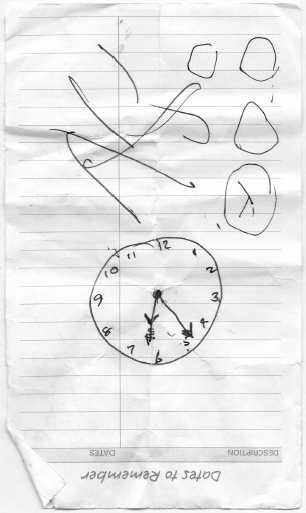
One evening I asked him to draw a clock that showed 6:24.  I tore a page out of my little datebook for him to draw on. “A.M. or P.M.?” he asked.

“A regular old fashioned clock, silly,” I said.

His drawing is below. My scribbles at the top were to show him how a lot of people with dementia draw a clock.  At the bottom is Peter’s clock.  I complimented him on his preciseness, especially the big hand showing twenty-four minutes past the hour. “The little hand isn’t quite right,” I said.  “Close, but no cigar.” Screen shot 2014-08-09 at 12.17.21 PM_2
Nunh unh, no-o,” he said. “When the big hand is coming down, the little hand is moving ’round too. This is right!’

Why did I question an engineer? He was right, of course. The old line, Never ask an engineer the time or he’ll tell you how to build a clock, still applies.

Another year passed and it was apparent Peter wasn’t his old self. Increased memory loss, inability to come up with the words for common items, and confusion about time and place occurred daily. Worse, he was having trouble writing checks to pay bills, and doing routine chores.

Back to the neurologist we went.

She performed those same standard tests. He could no longer remember the three things, nor did he know the day, date, or year. She prescribed commonly used Alzheimer’s drugs: Namenda, to slow dementia’s progression, and Aricept to ease confusion.

Another MRI showed an increase of the “sticky stuff.” Damned plaque! I thought that was only found on teeth.

I scheduled yearly visits.

This past spring the doctor said he was “mid-stage,” though his ability to count backwards rapidly by sevens, another standard test, continues to astonish the doctor and me. I can barely count forward by sevens! But then he is an engineer, numbers and calculations are still easy for him. And he continues to do soduko and crosswords every day, though I’ve noticed a decline in both interest and accuracy.

Though the doctor said “mid stage” I’ve read ahead — he’s exhibiting some “late stage” symptoms. A month ago he couldn’t remember our granddaughter’s name when he saw her picture, he didn’t know what the garbage disposal was for, and simple one-on-one conversations are almost impossible.

Recently, he started working on his 1/78th scale Cutty Sark model ship again — he built the hull and did all the “easy” stuff years ago.  He hadn’t touched it for five years or more. I mentioned this to the doctor because it was encouraging, even though I know there’s no hope for true improvement or cure. She suggested getting him a set of Legos “after he finished the boat.” Peter didn’t react, but I was insulted for him. This isn’t a bathtub toy he’s building after all!

During the visit she asked if he noticed changes in his memory. He said he knew he was “having a hard time,” but he could never forget me. Ah, he can still layer on that olde English charm when he wants to. And the doctor laughed.

Screen shot 2014-08-09 at 12.17.21 PM_3

Laugh anytime.

The next day I happened to come home from a luncheon with my name tag still in place. “Oh, I remember your name,” he said.

“You’d better!” I said.

He pointed to my tag and laughed. I didn’t see that one coming.


Header photo: Rainbow on the eastern shore, Virginia, 2013

2016 National Society of Newspaper Columnists’ contest finalist. 

Laughter layered with despair.

It’s likely that my husband’s dementia was festering years before I recognized it. What I called eccentricity was probably the early stages of the disease that wasn’t diagnosed until about five years ago.

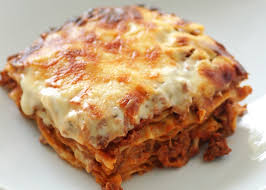
In my mind I see the disease as a pan of lasagna: love, passion, sweetness, gentleness, caring, laughter, and kindness are layered with frustration, rage, shouting, fury, stubbornness, silence, tears, and despair.

When I started writing draft posts for this new blog, Peter asked what I was doing? “I have to submit something for my Writers’ Group to critique next week,” I said.

“Nothing going on this evening then?” he asked. It was a Monday.

“Only if you’ll go to campus with me.”

“What for?”

“To work. Remember, I’ve volunteered at the Hort Gardens for thirteen years? I haven’t gone at all this spring, but if you’d come…?” I could have said, but did not, “I haven’t gone because I’m afraid to leave you alone in the evening.”

“What do they have to eat?” he asked.

I spluttered. “N-nothing, it’s…” Then I saw his eyes crinkled with laughter.

“I’ve got to stop doing that,” he said. He always says I’ve got to stop doing that when he realizes I’ve taken his teasing seriously yet again.

“Don’t ever stop trying to make me laugh,” I warned.

He laughed again. He loves it when, as he puts it, I give as good as I get. Our banter probably sounds cruel to others, but it has always worked for us, and it works even better nowdays.

Header photo: Peter,  North Rim, Grand Canyon, September, 2011

2016 National Society of Newspaper Columnists’ contest finalist.