Two good days in a row.

Sometimes I think of my  husband’s dementia as a scrim painted to look like a lowering storm. Occasionally, a break in the clouds appears — a rip in the backdrop – to let brilliant light stream through.

DSC01648

Sometimes a ripped scrim is a good thing.

We had two brilliant days this past week.

When Peter is happy and busy he whistles a tuneless few notes over and over. Those two days he bustled around the house, tidying here, straightening there, always whistling. He cleaned the fireplace, laid a fire, made lists, and never once, did he stand in the middle of the kitchen trying to remember where the coffee mugs were. He hasn’t bustled in months!

Two whole days!

He instigated conversation about our grandchildren, Sam and Miah, asked if Carolynn and Bill were snowed-in up north, remembered the recent visit by friends Shelia and Jerry, and willingly watched two Netflix movies in one evening.

Of course it didn’t last, but it was good while it did.

This morning around nine o’clock he was watching football, Manchester United vs Chelsea, when I told him was going for my walk. I went up the hill to the golf course and meandered around enjoying the bright day and the brisk wind. When I got back after nearly an hour, Peter met me at the door. “Martin was just here,” he said, “but I missed him. I left because I thought you were here.”

“I went for my walk, remember? But if you missed him, how do you know he was here?”

“I saw him when I was taking Nobby out.”

“You didn’t stay to talk to him?”

“No, I was going out. He seemed to know what he was doing.”

Then I saw a scribbled note from Mart: Judy, soup & ham in fridge.

I called Leslie to thank her for the soup and asked for the rest of the story. She’d needed to borrow my blender, Martin knew where it was, so it didn’t matter that Peter left the house as he arrived. I apologized. “An hour is a long time for Peter to remember something, Mom,” she said.

Later, Peter came and stood beside me as I was writing this. His head drooped, his arms hung limp at his sides. “What’s wrong?” I asked.

“I don’t know. There’s ‘stuff’ in the fridge, and I don’t know why Martin was here.”

“It’s all sorted, don’t worry. He brought soup and borrowed the blender. It’s OK.” He allowed me to hug him.

“It is Saturday, isn’t it?” he asked. I shook my head. “But football’s on…Sunday then?” I nodded.

He sighed. “I can’t remember things for ten minutes!” he mumbled into my shoulder.

“Hm-m, ten minutes might be stretching it,” I said.

He laughed, gave me a little hug, and went back to the telly. By this time ManU had whomped Liverpool, 3-nil, and Swansea and Tottenham were playing.

DSC00425

Tottenham 2, Swansea 1.

Photos: From our travels, to Baja California, Mexico, Alaska, and a North Carolina beach.

2016 National Society of Newspaper Columnists’ contest finalist. 

When the edge is gone.

Our son-in-law Martin launches into contemplative ruminations occasionally, usually about some subject so obscure that no one knows what he’s talking about. We all laugh and pay him no nevermind. Some eyes may glaze over as he rambles.

Not long ago, Leslie and Martin, Peter and I went out to dinner. Leslie and I chattered about this and that, Martin chimed in now and then, and Peter listened, silent as usual.

Into a gap in the conversation Martin said, “You know, Pete reminds me of a well-loved old kitchen knife. A very good knife, once sharp, but a bit dulled by time and use.” Leslie and I chuckled, and Peter smiled as if he got it, but I know he didn’t. Martin was pleased with his metaphor and, I admitted, it was a good one.

Old knives did all sorts of jobs in the right hands — they peeled apples and potatoes, chopped cabbage, loosened sealed jars, dismembered chickens, even acted as screwdrivers in a pinch. Even when they don’t hold their edges anymore, those knives still hold pride of place in kitchen drawers, for sentimental reasons, if for nothing else.


Screen shot 2014-12-07 at 12.50.18 PM

My great-granddad Tommy’s whetstone and an old knife from my drawer.

Header photo:  Veg for stew or for the compost bin?

2016 National Society of Newspaper Columnists’ contest finalist. 

Double whammy in four pages and sixteen hundred words!

Comedian Jerry Seinfeld opened the door for me — figuratively, not literally.

Brian Williams, NBC Evening News, did an interview with Seinfeld (11/6/14) to showcase his fifth season of “Comedians in cars getting coffee” web series. Seinfeld veered from the topic however, when he told Williams he’d decided he was someplace on the Autism Spectrum. He’d seen the Broadway play “The curious incident of the dog in the nightime” based on the book by Mark Haddon, and he recognized himself in lead character Christopher Boone. Young Boone, uncomfortable with eye contact, being touched, and with people in general, all common autism traits, is not labeled in the book or the play.

Screen shot 2014-11-11 at 11.22.04 AM“I’ve always been a literal person,” Seinfeld said. “So, if someone says [their child] is the ‘apple of their eye’ I don’t know what that means. There’s no ‘apple’ in an eye.”

He went on to say he’s observed in himself behavior that makes him think he may have autism. “I think, on a very drawn-out scale, I’m on the spectrum,” he said. “Basic social engagement is really a struggle. … But I don’t see it as dysfunctional. I just think of it as an alternate mindset.”

When I watched the interview and a follow-up the next evening, I realized it gave me the opening I’d been looking for to go beyond dementia in this blog. In “Thinking for two” (9/15/14), I wrote: “What keeps Peter somewhat steady, I think, is that he is now, and always has been, so bloody single-minded, the effects of a separate issue. I never thought I’d be glad that was the case.”

The “separate issue” I hintedatwas known as Asperger syndrome (AS) until two years ago. For some years, AS was considered a less severe form of autism. Long before dementia and possible Alzheimer’s disease entered our lives, Leslie described AS to me. I’ve always loved hearing my daughters talk about their careers, Leslie’s teaching related to autism spectrum disorders,* and the drama that is inherent in Carolynn’s oncology nursing field.

[*The American Psychological Association did away with the term Asperger’s Syndrome in 2012. But it was years earlier that Leslie enlightened me about AS, so I will use the term here, and stand corrected by my daughter later.]

In our long-ago conversation Leslie explained that people with the diagnosis frequently were slow to talk as children, unable to converse as adults, couldn’t look others in the eye or show emotion, and they weren’t necessarily personable.

“That sounds like Peter!” I said. “His mother had a stack of books she’d read when he was little to try to figure out why he wouldn’t talk. He was such a loner, but always comfortable with much older people or much younger children.” That was still true. I didn’t know whether to laugh or cry.

“I didn’t know all that, Mom,” Leslie said, “but, you’re right, a lot of of the characteristics apply, and goodness knows he’s uncomfortable in social situations.”

She said she’d test him — Leslie can get Peter to agree to anything — and thus that part of our journey began.

Screen shot 2014-11-16 at 2.40.26 PM

Yet another good thing.

My husband has always been a picky eater. He has always insisted he is selective, not picky. As long as there’s meatpotatoesveg on his plate, he’ll clean it, he says. If there’s gravy, so much the better, even lumpy gravy! He doesn’t like things that sound as if they were bought at a health food store — quinoa, wheat germ, tofu, edamame — although he has eaten all of them unknowingly, and liked them.

The list of things Peter will not eat is varied: tomatoes, the teeniest, eensiest bit of fat, cucumbers, pasta, rice, cheesecake, peanut butter, mac and cheese, cornbread, dill pickles, quiche, cranberries…I could go on.

Nowdays, because he doesn’t — can’t — cook anymore, he eats what’s put in front of him. This change allows me to fix meals I like more often instead of always catering to the meatpotatoesveg dictum.

Used to be, if I fixed pasta, which I love, he’d mutter and growl. Now we have it once a week or so and he doesn’t say a word. Maybe he doesn’t remember he never liked it, or maybe he likes it now, I don’t know. Other meals, I’ll sometimes fix two green veg, no potatoes, and substitute beans for meat. Not. A. Whimper.

Recently I prepared turkey cutlets and quartered red potatoes marinated in lemon juice, rosemary, and olive Screen shot 2014-10-30 at 6.05.01 PMoil. Cranberries I cooked in hard cider, with a smushy apple, and a bit of sugar. Yummy. I nearly fell off my chair when Peter not only cleaned his plate, but carefully scraped out the tiny bowl of cranberries I’d given him and served himself some more!

He pointed to the bowl and said, “Are they good for me?”

I nodded, he smiled, then licked his spoon.

Thanksgiving is upon us. Cranberries!

Another good thing to be thankful for — check

Screen shot 2014-10-31 at 9.32.51 AM

2016 National Society of Newspaper Columnists’ contest finalist. 

Another good thing.


Screen shot 2014-11-03 at 9.38.05 AM

Screen shot 2014-11-05 at 10.29.40 AM

For years, my husband has had bouts of hiccups that sometimes last for days. And sometimes his hiccups predict when he’s going to have a very bad head cold.

Such was the case a few weeks ago. Violent hiccups started in the evening, and by the next morning he could have starred in a Nyquil commercial — sneezing, coughing, aching — with hiccups thrown in for good measure. This went on day and night for four days. None of the usual “cures” work, not drinking from the opposite side of the glass, holding his breath, a scare, nor a spoonful of sugar.

Occasionally the hiccups stopped and I’d hope they’d ended. But I didn’t want to say anything lest I jinx him. “Doesn’t your chest hurt?” I asked midway through the ordeal.

“No, why?”

“I just think hiccuping so often would make your chest hurt.”Screen shot 2014-11-05 at 10.37.59 AM

“Hiccups? I don’t have hiccups!” he growled.

I shut up because, in that case, not remembering was a good thing. Never mind that in an hour they’d start again.

Stop.

 Start.

STOP!

The following week he didn’t remember the horrible cold nor the hiccups, and if his chest ever ached, he didn’t remember that either.

Sometimes, not remembering is a good thing, right?

Check … imagesor  not check? Screen shot 2014-11-05 at 5.27.36 PM


2016 National Society of Newspaper Columnists’ contest finalist. 


One good thing.

In my husband’s case, his continuing sense of humor makes a horrible disease tolerable for both of us. Plus, I’ve discovered there are several things that are “good” about his dementia.

Peter doesn’t know how to describe pain, not even in the moment. Maybe he never did and I’m only now noticing. He can’t say if pain is sharp, dull, throbbing, piercing. He can’t say if it’s a three or a nine on a scale of ten.

Several months ago, he came to me nearly doubled over with pain. His shoulder was scrunched up towards his ear and he was gripping the back of his neck.  “I don’t know what this is, but I need to go to the doctor,” he said, grimacing.

My husband never thinks he needs to see a doctor, and he never complains that he hurts. I calmed both of us down with a cup of tea, and after questioning him, I decided he’d had muscle spasms, not a heart attack. That was a Friday evening.

I watched him over the weekend, and though he winced from time to time, he never said another word. But Monday morning he complained again so I made an appointment to see the doctor.

By the time we arrived, he had no pain and no memory of it. I knew he hadn’t been faking, but I couldn’t believe he didn’t remember. Further, he didn’t know why we were in the doctor’s waiting room! When I asked how he felt, he shook his head dismissively, and shrugged his shoulders. Then he stood and patted himself down — chest, back, arms, legs — and said, “Yep, I ‘feel’ just fine.” His eyes twinkled.

The doctor said arthritic spurs on his upper spine were making the nerves twang like  too-tight banjo strings. He prescribed ointment, pain pills, and physical therapy.

One good thing— check!Screen shot 2014-10-20 at 4.32.19 PM

Header photo: Sweet state in a North Carolina garden.

2016 National Society of Newspaper Columnists’ contest finalist. 

 

Give us this day.

The other morning we went to a favorite spot, Our Daily Bread, for coffee and pastries. While I waited for Peter to finish drooling over the cases of beautiful cakes and cookies, I watched a man about my husband’s age wandering alone near the cashier’s line.  He kept his eyes on a woman at a table across from ours, and finally he made his way towards her.

Screen shot 2014-10-26 at 2.51.40 PM

Photo, Our Daily Bread.

After we finished Peter said, “I could eat another one, couldn’t you?” I ignored him, as I always do, and he laughed, as he always does.

We exited near the table where the man I’d noticed earlier sat quietly. The woman, obviously his wife, stood behind him, arms extended over his shoulders, slicing a croissant into manageable bites. She never stopped chatting with her friend, and he never seemed to notice he was being helped. She was doing for him what she’d probably done for their children when they were toddlers.

I thought, how lucky we are that Peter is still able to help himself, most of the time, so far.

Header photo: Butterfly visit.

2016 National Society of Newspaper Columnists’ contest finalist. 

Yesterday was not a good day.

Peter could not remember how to do the simplest of jobs, he was grumpy because I was “telling him what to do,” and I was grumpier because I had to repeat myself endlessly. Meanwhile nothing got done.

Besides, it was an ugly windy day, completely unlike what the weather forecaster predicted.

Late in the afternoon, Peter came to me and asked, “Is there anything else I can do wrong?”

He had a plaintive smile, and of course I melted. “I’m sorry I’ve been so grouchy,” I said.

“No, you haven’t, don’t even say that,” he said. He wrapped me in one of his increasingly rare hugs.

“But you didn’t do anything ‘wrong,'” I said, “you just didn’t do anything.” He loves it when I jab him.

He laughed and danced around the kitchen like an elf. “Ya got me!” he said, and everything was alright again.

Header photo: Wildfire damage in Wyoming, 2011.

2016 National Society of Newspaper Columnists’ contest finalist. 

Debit or credit?

About a year after my husband was officially diagnosed I discovered a big error in our checking account. Since I almost never wrote checks it was a double whammy — I hadn’t made the mistake, but I knew who had. Quicker than I could subtract what had been added, the bill-paying and taxes-doing landed in my lap.

I’d always relied on Peter, so good with numbers and so logical, to take care of everything involving money matters, never my forte by any stretch. Until that day I had no inkling that he’d lost those skills. Taking over those tasks was no laughing matter for me, a words person. People laugh when I say, “I don’t do numbers,” but I don’t…didn’t.

Now I do.

I found a CPA to help with the taxes, and son-in-law Martin set up automatic bill paying to ease things for me. This created suspicion, a common dementia symptom, in Peter’s mind. He did not like that I had commandeered the checkbook. He didn’t trust “automatic” and,Screen shot 2014-09-21 at 4.32.55 PM worse, he didn’t trust me, with good reason — my own bookkeeping history before we were married was abysmal. It was months before he was even moderately comfortable with the idea that I had taken over his job and that the checkbook was no longer his domain. He still doesn’t understand that the need for anyone to write checks is all but gone.

I’d write a check for any amount if I could reverse Peter’s mental decline.

He had always been in charge and suddenly he wasn’t. Not easy to deal with. Now he’s forgotten there are even any bills to pay, taxes to file, or investments to manage. And I’d never been in charge of such matters, but now I am. Not easy to deal with either. I wanted to scream and sometimes, oftentimes, I do. Or I go to the basement and throw sneakers at the wall.

Screen shot 2014-09-21 at 4.39.24 PMThen one day, I told Peter to cut-up his bank debit card because I thought it was his old, expired credit card. When I realized my mistake, I said, “I owe you an apology,”

He didn’t miss a beat. “That’ll be ten dollars, please,” he said.


Header photo: Graceful anemones, Montreal Botanical Gardens, 2010

2016 National Society of Newspaper Columnists’ contest finalist. 


Picking up sticks is about control.

These days, my husband attends to specific tasks he sets for himself whether they need doing or not, repeating the steps carefully, obsessively. I bite my tongue and turn away because I want to scream, “Please do something that helps. I’m doing everything and you’re picking up *#! sticks!”

Screen shot 2014-10-05 at 4.29.40 PM

When I sat down to write this post, he was doing it again, right outside my window — collecting twigs that were blown off the trees during two days of high wind. In his mind, I think, he knows tiny sticks are something he can still control.

In my mind, I wish he’d remember I asked him to mow the grass. Grass-cutting is on the list, a list he checks every thirty minutes or so, but never remembers. I learned long ago, as most wives do, nagging doesn’t work, dementia or no.

Ever since he retired, Peter has cleared the dishes willingly after dinner, but now he’s become obsessive about the task. He won’t leave the house to walk the dog unless the job is done, even when I tell him I’ll clear. To be honest, he doesn’t like the way I clean up! I’m not as fussy as he is.

He wipes our countertops endlessly to “polish” them, but to do it he uses any grungy cloth he finds under the sink from the supply I keep to wipe splatters off the floor. When I showed him the special granite-cleaning cloth he scoffed, so I use it secretly with the special cleaner when he’s not around. He gets very offended if I do or say anything that suggests he’s not done a job correctly.

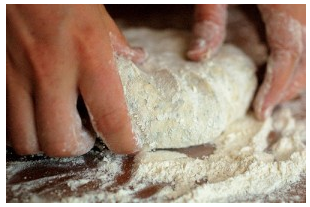
Once, when I made an even worse-than-usual mess baking bread, I had to leave it to attend to something else. When I returned to the kitchen, it was spotless. “Wow! Thank you for cleaning up my ‘bread mess,’” I said.

Screen shot 2014-09-22 at 6.22.25 PM

Peter’s eyes twinkled. He loves homemade bread. “Thank you for messing up my clean,” he said.

He’s still so quick, and of course I laughed.

Screen shot 2014-10-11 at 3.07.23 PM
So, no matter how frustrated I get, I try very hard to remember that my husband can’t help what is happening to him. I know he’d give anything, even his entire Mickey Mouse collection, to turn the clock back to a time when he was in control of his life.


Header photo: Peter imagines himself picking up all those sticks, 2008

2016 National Society of Newspaper Columnists’ contest finalist.